
BPC-157: Research Overview, Mechanisms, and Current Evidence
BPC-157 (Body Protection Compound-157) is a synthetic pentadecapeptide based on a sequence identified in gastric juice. It has been studied extensively in preclinical (animal) models for effects on tissue repair, blood vessel formation, and cellular protection, and is sometimes described in the literature as a cytoprotective compound. Human clinical evidence remains early and limited. The information below summarizes published research for educational and research purposes only. It is not medical advice and is not guidance for use in humans.
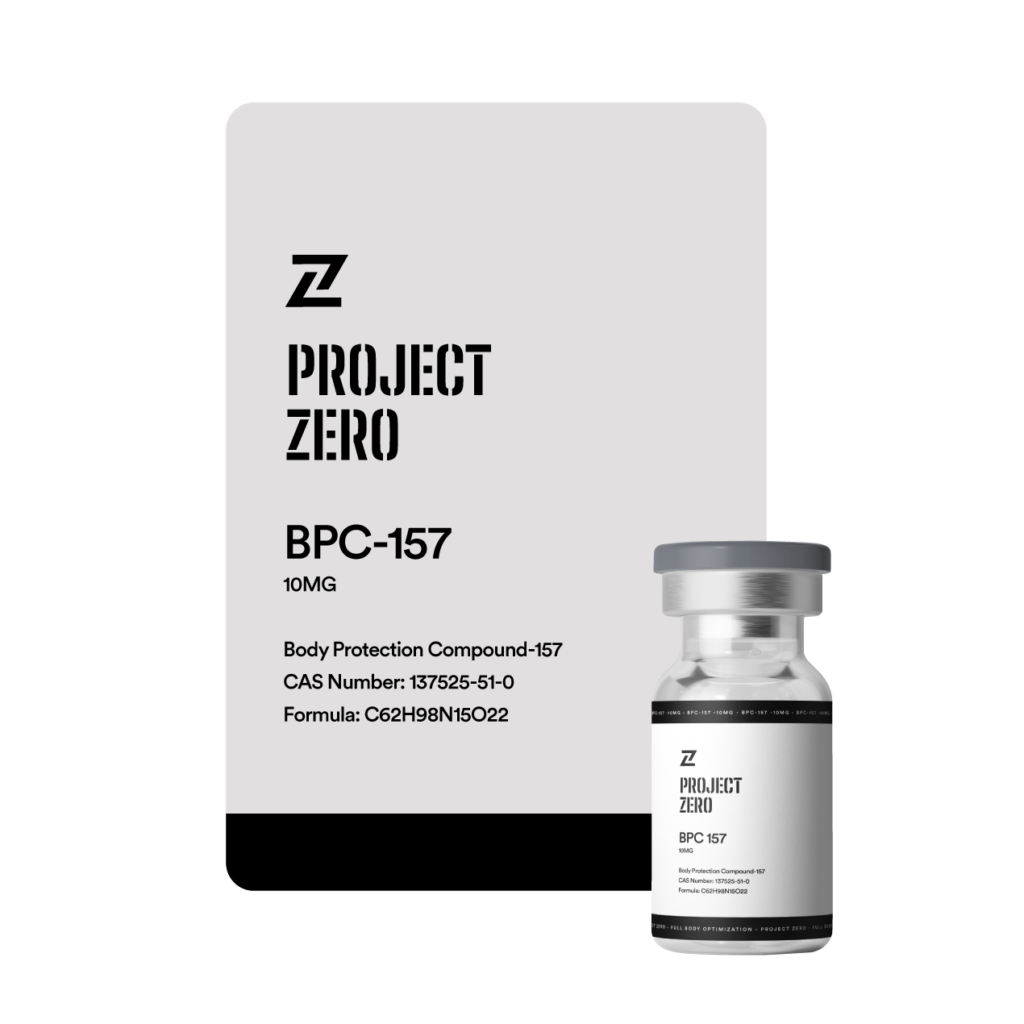 View at Project Zero
Available for research use from our preferred vendor, Project Zero. For laboratory research use only.
How It Works (Preclinical Mechanisms)
In preclinical models, BPC-157 has been reported to influence several repair-related pathways. These findings come primarily from animal and laboratory studies and have not been established in large human trials.
- Promotes angiogenesis (new blood vessel formation), reported to involve VEGFR2 signaling.
- Modulates nitric oxide production through the Akt to eNOS pathway.
- Supports collagen synthesis and fibroblast activity in connective tissue models.
- Reduces markers of inflammation and oxidative stress in experimental settings.
Areas of Research Interest
Published studies have examined BPC-157 in the following research contexts. Most evidence is preclinical; human data, where it exists, is limited to small pilot studies.
Musculoskeletal repair
Studied in animal models of tendon, ligament, muscle, and bone healing, with reported effects on soft-tissue recovery.
Gastrointestinal models
Investigated in preclinical models of the gut lining and mucosal integrity.
Vascular and cytoprotective effects
Examined for effects on blood vessel function and tissue protection, including early work in human arterial tissue.
Neurological models
Studied in animal models for effects on nerve tissue and neuroprotection.
Reported Study Parameters
For laboratory research use only. The table below reports the doses and routes used in specific published studies, with sources. It describes what researchers administered in these models and is not a protocol, recommendation, or guidance for use in humans or animals. Animal-study doses are expressed per kilogram of body weight.
| Research Model | Dose and Route Reported | Source |
|---|---|---|
| Lower-limb ischemia-reperfusion (rat) | ~20 µg/kg, intraperitoneal | Yildirim 2026·DOI |
| Vascular and multiorgan stress, adrenalectomy (rat) | ~10 µg/kg and ~10 ng/kg, intragastric | Smoday 2026·DOI |
| Aortic wall remodeling (rat) | ~10 ng/kg, intragastric | Smoday 2026·DOI |
| Human pilot studies | No standardized or validated regimen established | McGuire 2025·Mateescu 2026 |
Products are supplied as lyophilized powder requiring reconstitution. For reconstitution concentration math, use the Peptide Calculator.
Latest Research (2025 to 2026)
Recent peer-reviewed literature indexed on PubMed continues to characterize how BPC-157 works while clarifying how early the human evidence remains.
Mechanisms of tissue repair
A 2025 musculoskeletal review reports that BPC-157 activates VEGFR2 and nitric oxide synthesis through the Akt to eNOS axis, promoting angiogenesis and fibroblast activity, while emphasizing that human data are very limited and the compound should be considered investigational. PubMed·DOI
First signals in human arterial tissue
A 2026 study tested BPC-157 on human internal mammary artery segments and observed endothelium-dependent vasorelaxation mediated largely through nitric oxide, described as early mechanistic evidence in human tissue that requires further study. PubMed·DOI
Tissue repair and pain modulation
A 2026 review on regeneration and analgesia describes reparative and anti-inflammatory effects across preclinical models, noting that human research is confined to small pilot studies in musculoskeletal pain, interstitial cystitis, and intravenous administration, with no major adverse effects reported. PubMed·DOI
Pharmacology and development status
A 2026 biopharmaceutical review reports a plasma half-life under 30 minutes with intramuscular bioavailability of roughly 14 to 51 percent across species, and notes there is no approved formulation, no validated dosing regimen, and fewer than 30 human subjects studied across three uncontrolled pilots. PubMed·DOI
Sports and orthopaedic context
Two 2026 reviews place BPC-157 among popular peptides marketed to athletes, noting favorable preclinical results but scarce human validation, unknown standardized dosing, and regulatory considerations. A single uncontrolled human case series of intra-articular knee injection is described as having significant methodological limitations. PubMed·DOI·PubMed·DOI
Research Questions
How does BPC-157 compare to TB-500 in research?
In preclinical literature, BPC-157 is most often studied for localized tissue repair (gut, tendon, ligament), while TB-500 (a thymosin beta-4 fragment) is studied for more systemic effects on cell migration and recovery. Both are investigational, and head-to-head human data are lacking.
What is the current state of human evidence?
Human evidence is limited to a small number of uncontrolled pilot studies. No validated dosing regimen exists and no large controlled trials have been completed.
What does the available safety literature suggest?
The small human pilot studies reported to date have not noted major adverse effects, but the sample sizes are very small and long-term safety in humans has not been established.
Referenced Citations
Foundational and current literature, indexed on PubMed.
- McGuire, F.P., et al. (2025). Regeneration or Risk? A Narrative Review of BPC-157 for Musculoskeletal Healing. Curr. Rev. Musculoskelet. Med., 18(12), 611-619. PubMed·DOI
- Mateescu, D.M., et al. (2026). BPC-157 as an Investigational Peptide Therapeutic. Pharmaceutics, 18(5), 625. PubMed·DOI
- Yuan, C., et al. (2026). From Regeneration to Analgesia: The Role of BPC-157 in Tissue Repair and Pain Management. Int. J. Mol. Sci., 27(6), 2876. PubMed·DOI
- Yildirim, A.K., et al. (2026). Endothelium-Dependent Nitric Oxide-Mediated Vasorelaxant Effects of BPC 157 in Human Internal Mammary Artery. J. Clin. Med., 15(9), 3488. PubMed·DOI
- Mendias, C.L., Awan, T.M. (2026). Safety and Efficacy of Approved and Unapproved Peptide Therapies for Musculoskeletal Injuries and Athletic Performance. Sports Med. PubMed·DOI
- Mayfield, C.K., et al. (2026). Injectable Peptide Therapy: A Primer for Orthopaedic and Sports Medicine Physicians. Am. J. Sports Med., 54(1), 223-229. PubMed·DOI
- Sikiric, P., et al. (2018). Stable Gastric Pentadecapeptide BPC 157. Curr. Pharm. Des., 24, 1990-2001. PubMed
- Gwyer, D., et al. (2019). BPC 157 and accelerating musculoskeletal soft tissue healing. Cell Tissue Res., 377, 153-159. PubMed
- Chang, C.H., et al. (2011). The promoting effect of BPC 157 on tendon healing. J. Appl. Physiol., 110, 774-780. PubMed
PeptideInfo.org provides information strictly for educational and research purposes. All referenced products are intended for laboratory and research use only and are not approved for human consumption, medical use, or self-administration. Nothing on this page constitutes medical advice. Research summaries reference literature indexed on PubMed.